PixelPEC

Marta's Guests
CGAI Animated Film


about the project
Client: PixelPEC / In-house project
Target audience: Children & teenagers
Production: Hybrid CGAI
briefing
“Marta's Guests” is one of the first short films in Hesse to use generative AI on a large scale for a film production – conceived not as a technical demonstration, but as a standalone artistic work.
The film was directed by Christian Kaufmann, a graduate of the Film Academy Baden-Württemberg, whose graduation film “Town Hall Square” screened at over 100 festivals worldwide.


The plot
Marta, 92, lives alone; her daily life is marked by rituals – tea, the radio, and her famous homemade cookies. But her strength is waning, and even the recipe she’s known by heart her whole life no longer turns out right. When two rival aliens land in her garden and Marta’s home becomes an intergalactic battlefield, Marta rediscovers something in the chaos that she thought she had lost: the feeling of being needed.

Concept
“Marta’s Guests” tells its story entirely without dialogue – relying solely on visual storytelling, rhythm, and music. This lack of dialogue creates a universal understanding that transcends age and culture, making the film suitable for international distribution. AI is deliberately treated as an aesthetic tool: it does not generate the “what” of the story, but rather the “how” – comparable to the use of lighting, camerawork, or color in classical filmmaking. The film is not a technical case study, but a narratively grounded work that demonstrates how humans and machines can collaborate creatively without losing the essence of filmmaking.
Visual approach
The goal of the visual development was to achieve a tactile, “handmade” look with a palpable sense of spatial depth – an aesthetic that deliberately sets itself apart from smooth, generic-looking AI images. The starting point is hand-drawn illustrations by PixelPEC’s illustrators and storyboard artists, created in close collaboration with the directors. These drawings train a dedicated, project-specific AI that imbues the finished image with subtle imperfections and a sense of materiality, rather than flawless smoothness. In this way, every visual decision remains part of a deliberately designed, human-guided process.
Die Figuren

Marta
Marta – the 92-year-old protagonist: warm-hearted, lonely, sustained by rituals. Her increasing frailty makes her encounter with the stranger a matter of courage rather than fear.


Zefet
An injured, helpless alien whose spaceship crashes in Marta's garden. His arrival forces Marta to let her instinct to help overcome her fear of the unknown.


Q
A hostile alien from another species who is pursuing Blufet. The conflict between the two turns Marta's kitchen into a battlefield – until a stroke of luck defuses the situation.


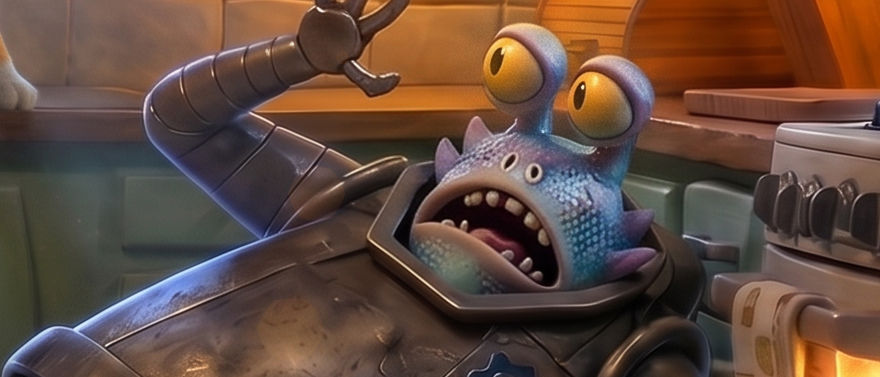

Hybrid Production Method:
Scribbles, AI, and Compositing
The best of both worlds – combined methodically.
There is no “silver bullet” in this emerging production method: what matters most is the creative combination of methods, shot by shot.
Each scene begins with hand-drawn scribbles, which are used to create still images for the animatic. This animatic provides a solid foundation for timing and dramaturgy and translates directly into precise prompt descriptions, which are then used to generate the sequences as AI-generated video.


At the same time, these same scribbles serve as the starting point for standalone AI-generated still images that define the look and mood of the scenes. All the results ultimately come together in the compositing phase: For each shot, the strongest solution from the animatic, AI video, and AI still image is combined, and wherever the visual language requires it, manual work is applied in a targeted manner to refine the result.


Why This Hybrid CGAI Approach Works
Pure AI generation would quickly come across as arbitrary with such a subtle, emotional subject matter.
Director Christian Kaufmann sums it up:
“I don’t see technology as an end in itself, but as a partner in the creative process. AI never takes over the story itself, but only its texture: in this context, AI doesn’t generate the ‘what,’ but the ‘how.’ Accordingly, the film is not intended as a technical feasibility study, but as a standalone work. This approach makes ‘Marta’s Guests’ a concrete, poetic contribution to the current AI debate in the film industry.”


